TL;DR - Key takeaways:
- A battery stores electricity, an inverter converts it, and an EMS decides when it should move.
- LFP is the most common technology for commercial storage, with typical AC efficiency around 88–94%.
- Storage helps farms use more of their own wind and solar power and reduce demand peaks.
- The right system starts with your farm’s energy profile: when you generate, when you use power and where the bottlenecks are.
If you already know what a commercial battery is and why a farm or business might install one, the next question is practical: what is actually happening inside the system?
An energy storage system is a chain of components that store electricity, convert it into the form your business can use, and decide when that electricity should move. The battery gets most of the attention, but the inverter and Energy Management System, or EMS, are just as important.
For farms, this matters because production and demand rarely line up perfectly. Solar panels produce most around midday. A wind turbine will produce more in the evening, overnight, or during winter. Meanwhile, milking, cooling, ventilation, and everything in between follow the rhythm of the business.
This article complements our guide to commercial battery storage. That guide covers the business case. Here, we focus on how an energy storage system works mechanically, how much electricity comes back out after storage, and how the system decides when to charge or discharge.
What components make up an energy storage system?
Most business energy storage systems can be understood as three connected parts:
- Batteries, where electricity is stored
- An inverter, which converts electricity between DC and AC
- An EMS, which coordinates charging, discharging, generation, consumption and the grid
A complete installation also includes protection equipment, cabling, meters, battery management hardware and, depending on the system, cooling and transformers.
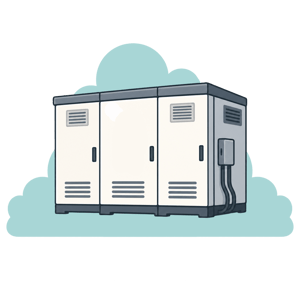
Batteries
The battery stores electricity as chemical energy.
In lithium systems, individual cells are grouped into modules, then racks or cabinets. During charging, ions move inside the cells while electrons travel through the electrical circuit. During discharge, that process reverses, and electrical energy becomes available again.
A Battery Management System, or BMS, watches the cells throughout this process. It checks cell voltage, temperature, current, and state of charge so the battery stays within its operating limits.
Ecoways currently works with several commercial storage platforms:
|
System |
Type |
Power |
Capacity |
Notes |
|
Pixii |
LFP |
From 50 kW |
From 51 kWh up to 225 kWh |
Modular outdoor storage |
|
Kaifa |
Lithium-ion |
30–125 kW |
104–261 kWh |
Outdoor, liquid-cooled |
|
CESC Mercury 233 |
LFP |
105 kW AC |
233 kWh |
All-in-one outdoor system |
|
QurmitXL |
Lead-gel |
Depends on configuration |
57–800 kWh |
Indoor storage |
These systems cover quite different use cases, from modular outdoor setups to larger indoor storage. The important thing is to match the system to your site's power demand, storage needs and available space.
There is also an important distinction to note: kW and kWh are not the same thing.
Kilowatts, or kW, tell you how much power a battery can deliver or absorb at one moment. Kilowatt-hours, or kWh, tell you how much energy it can hold.
A farm with a short demand spike may need a different kW-to-kWh balance from a farm that wants to cover several hours of steady evening use.
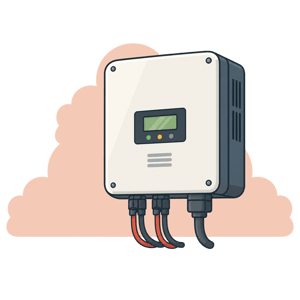
Inverter
Battery cells store electricity as direct current, or DC. Most farm equipment, buildings, and the public grid use alternating current, or AC.
The inverter converts between the two.
When an AC-connected battery charges, the inverter converts AC electricity into DC for storage. When the battery discharges, it converts DC back into AC so the electricity can run equipment or move through the site's electrical installation.
Solar systems can be arranged in different ways, so the exact route varies. In an AC-coupled setup, solar electricity has already passed through a solar inverter before reaching the battery system. In a DC-coupled setup, generation and storage can share part of the conversion path.
Every conversion loses a small amount of energy. That is one reason you never get exactly 100 kWh back after putting 100 kWh into a battery.
The inverter also sets how quickly energy can move. A 200 kWh battery paired with a 50 kW inverter cannot deliver all 200 kWh in one hour.
The kWh figure is the tank size. The kW figure is the rate at which energy can enter or leave it.
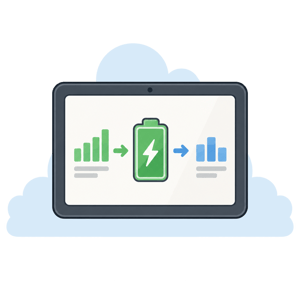
EMS (Energy Management System)
The EMS is the control layer.
An EMS is hardware and software that measures, analyses and controls energy flows across a site. Ecoways works with Tweaq, a Dutch EMS provider based in Veldhoven, to connect assets such as wind, solar, storage, smart meters and business loads.
The EMS deals with three questions throughout the day:
- Where is electricity being produced?
- Where is electricity being used?
- Where should the next kilowatt-hour go?
At 13:00, your solar panels may be producing more than the farm needs. The EMS can send that surplus into the battery.
At 17:00, milking, cooling, or charging may push demand above on-site generation. The EMS can discharge the battery to cover part of that peak.
An EMS can also take energy prices, export limits, battery reserve, and grid constraints into account. The battery then follows the priorities set for the site.
How the charging and discharging process works
Mechanically, the cycle has five stages:

- Electricity is generated or imported
- The EMS measures production and demand
- Available surplus is converted and stored
- The battery holds that energy until it is needed
- Stored DC electricity is converted back to AC and used on-site
The exact route depends on the installation, but the principle stays the same.
Charging: When and how the battery fills up
Charging usually starts when there is more electricity available than the business is using.
Imagine a dairy farm with solar panels and a wind turbine. Around midday, solar output may be high while the largest morning demand has passed.
The EMS detects the surplus and checks the system rules. How full is the battery? Is there an export limit? Does the battery need to keep a reserve for later? If dynamic energy prices are part of the setup, what does electricity cost at that moment? What is electricity likely to cost tomorrow?
If the battery should charge, the inverter supplies DC electricity at a rate the battery can accept. The BMS watches cell conditions as the state of charge rises.
When the battery reaches its permitted upper limit, the EMS needs another destination for any remaining electricity. Depending on the setup, that may be direct use, grid export, limiting generation, or shifting a flexible load such as EV charging.
Discharging: When stored energy is put to use
When demand rises above current wind and solar generation, the process reverses.
DC electricity leaves the battery, passes through the inverter, and becomes AC electricity for the farm.
That could happen during milking, when cooling compressors start, when pumps run, or when several chargers are active.
Price can also be part of the logic. With a dynamic contract, the EMS may preserve stored electricity when grid prices are low and use it later when buying electricity costs more.
Efficiency: How much energy do you actually get back?
Just the basics |
|
A battery does not return every kilowatt-hour you put into it. Some energy is lost during charging, storage, and conversion. This is measured as round-trip efficiency. If a battery takes in 100 kWh and later delivers 92 kWh, its round-trip efficiency is 92%. For LFP batteries, a typical AC round-trip efficiency is around 88 to 94%. Lead-acid systems are usually lower, at around 70 to 85%. For most businesses, the practical point is straightforward: the higher the round-trip efficiency, the more of your stored electricity you get back to use on-site. |
Extra for Experts |
|
The exact efficiency figure depends on where you measure it. At DC level, LFP systems can reach around 96 to 98% because the measurement looks mainly at the battery itself. At AC level, where the inverter and other system components are included, efficiency is lower. SunLith gives a typical AC range of 88 to 94%, while Energy Shift cites 92 to 95% for LFP systems. That difference matters when comparing systems. An AC figure usually gives a better picture of what actually comes back into your electrical installation. Several things affect the final result:
If you are comparing battery systems, check whether the stated efficiency is measured at DC level or AC level. That one detail can make two systems look closer, or further apart, than they really are. |
Which battery technology is most commonly used?
Just the basics |
|
For commercial energy storage, lithium-ion batteries are currently the most common choice. Within that category, lithium iron phosphate, usually shortened to LFP or LiFePO4, is widely used. LFP is popular because it combines a long cycle life, good thermal stability and high efficiency. A typical LFP battery can handle around 6,000 to 8,000 charge cycles, with lithium-ion systems often lasting around 10 to 15 years in practice. The exact lifespan depends on how often the battery is charged and discharged, how deeply it is discharged, operating temperature and the system settings. Ecoways uses LFP technology in systems from Pixii and CESC. For indoor storage, QurmitXL uses lead-gel technology instead. For a farm, battery chemistry is only one part of the decision. Capacity, discharge power, location, warranty and how you plan to use the battery all matter too. |
Extra for Experts |
|
LFP has become widely used in commercial storage because the chemistry is well suited to frequent cycling and stationary applications. Compared with some other lithium-ion chemistries, LFP generally offers:
Other chemistries are developing too. Lead-gel is already in use in commercial systems such as QurmitXL. It has lower round-trip efficiency than LFP, but can suit specific indoor storage setups. Sodium-ion replaces lithium with sodium as the active material. It is attracting attention because sodium is widely available and could reduce dependence on lithium. Flow batteries store energy in liquid electrolytes held in separate tanks. They can suit larger, longer-duration storage applications because power and energy capacity can be scaled separately. RVO expects technologies such as sodium-ion and flow batteries to play a larger role as the storage market develops, with flow batteries expected to start entering the market around 2027 or 2028. For most farms today, though, the chemistry discussion quickly becomes practical: how often will the battery cycle, how much energy needs to be stored, how quickly must it discharge, and where will it be installed? Those questions usually matter more than the chemistry label on its own. |
Indoor or outdoor: what determines the best placement?
Placement starts with the site.
How much capacity do you need? Where is the main electrical installation? How much space is available? Can installers and service teams access the battery safely? How will cables reach the connection point? What safety requirements apply? Will the system need extra capacity later?
Ecoways looks at current energy use, wind or solar generation, peak demand, grid connection, placement, backup needs and future plans before selecting a storage setup.
Outdoor battery storage: space, foundations and safety distances
Outdoor systems often suit larger capacities, higher demand, renewable generation, EV charging locations and sites where later expansion may be needed.
The location needs room for the cabinet, safe access for installation and maintenance, a suitable cable route and a workable connection to the existing electrical system.
Some outdoor systems also need foundation preparation and specific safety distances from buildings or other site features. The exact requirements depend on the model, the site, permit conditions and the electrical design. Ecoways currently supplies Pixii, Kaifa and CESC as outdoor storage options.
On farms, outdoor space can make this route practical, but vehicle access, drainage, cables, fire safety and maintenance space still need to be checked before choosing a location.
Indoor battery storage: when it is the more practical choice
Indoor storage can work well when outdoor space is limited, foundation work is awkward, or the battery can sit close to an existing electrical room or distribution board.
Ecoways uses QurmitXL for indoor storage. It is built from inverter/charger units, a distribution unit and lead-gel battery cells, with capacities from 57 to 800 kWh.
Ecoways states that QurmitXL is designed for indoor installation and is not covered by PGS battery-storage requirements. A site assessment still matters, and permit, electrical and insurer requirements should always be checked for the individual installation. RVO also advises businesses to verify local permitting and safety requirements before installation.
What is an energy storage system used for?
For farms and rural businesses, battery storage is mainly about using your own energy at a better time, reducing short demand peaks and getting more from a limited grid connection.
Battery storage for solar panels: storing daytime surplus
Solar panels often produce most when demand is lower. A battery stores that surplus and makes it available later for cooling, machinery, lighting or charging.
The same applies to wind. Because wind and solar often generate at different times, combining both with storage can give a farm a steadier supply of its own energy across the day and year.
Battery storage for industry: covering short demand peaks
Battery storage for industry is often used when machinery, cooling systems or EV chargers create short spikes in electricity demand.
The battery supplies part of that extra power, so the grid connection does not have to carry the full peak.
On a farm, the same principle can apply when milking, cooling, pumps or charging happen at the same time.
Managing peak demand and grid congestion
This is becoming increasingly relevant in the Netherlands. At the end of 2025, 15,014 requests for electricity offtake capacity and 8,687 requests for feed-in capacity were waiting at regional grid operators.
A battery cannot create extra grid capacity, but it can reduce how much power a business needs from the grid at peak moments.
For example, if a farm normally draws 60 kW but briefly jumps to 100 kW, the battery can supply part of that extra demand. This is called peak shaving.
From 1 July 2026, small and large consumers in congested areas also enter the same queue for new or heavier connections. In some cases, businesses that demonstrably free up grid capacity can receive priority, although this does not guarantee immediate access.
Battery sizing should therefore start with the farm’s actual energy profile: when electricity is produced, when demand peaks, and what future machinery, charging or expansion plans may add.
Backup during power outages
A battery can keep critical farm equipment running during an outage, but backup has to be built into the system.
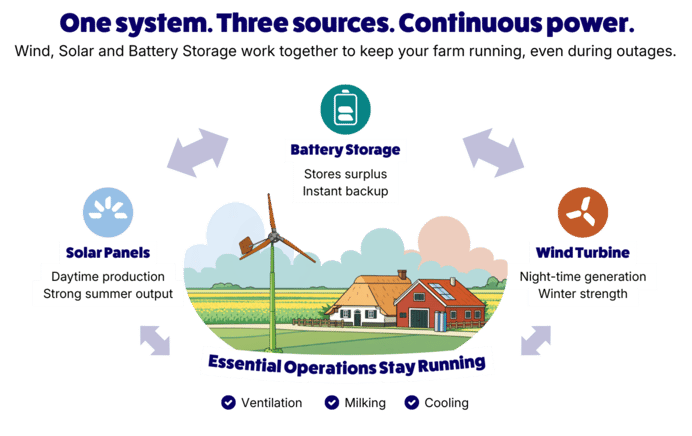
For example, QurmitXL can be fitted with an Automatic Transfer Switch to safely switch selected loads away from the grid. The key question is what you need to keep running, such as ventilation, cooling, or controls, and for how long.
That determines the battery power and storage capacity you need.
FAQ: Permit process for small windmills
How big should an energy storage system be for a farm?
There is no standard farm battery size. Capacity should be based on your electricity profile, generation, demand peaks, grid connection and the task you want storage to perform.
Ecoways assesses current use, wind and solar production, peak demand, backup requirements and future plans before recommending a system.
How long does a business battery last?
LFP batteries are often specified around 6,000 to 8,000 cycles, with lithium-ion lifespan estimates commonly around 10 to 15 years.
Actual life depends on chemistry, temperature, cycle frequency, depth of discharge, operating strategy and warranty.
Can a battery work with existing solar panels?
In many cases, yes.
The electrical design determines how the existing solar inverter, battery inverter, EMS and grid connection work together. Compatibility should be checked before choosing the battery.
Can I combine battery storage with a wind turbine?
Yes. Wind and storage can work well together because wind often generates at different times from solar.
An EMS can store surplus wind electricity and release it when farm demand rises.
Will a battery keep my farm running during a power cut?
Only when the system is configured for backup.
This requires switching equipment and an electrical design that separates critical loads safely from the grid. Decide which processes must continue and for how long before sizing the system.
What efficiency should I expect from a business battery?
For LFP, published AC round-trip efficiency figures commonly sit around 88 to 94%, with higher figures when efficiency is measured only at DC battery level.
Compare systems using the same measurement boundary.
The Takeaway
An energy storage system coordinates three jobs: storing electricity, converting it and deciding when it should move.
The battery holds the energy. The inverter moves electricity between DC and AC. The EMS watches your farm, generation and the grid, then decides when the battery should charge or discharge.
For farms producing their own wind or solar power, storage helps match generation with demand. It can also reduce peaks, make better use of a limited grid connection and, when configured for backup, keep critical processes running during an outage.
Start with your energy profile, then build the battery around it. The right system should fit how your farm actually runs today and where you want it to go next.
Considering a small windmill for your farm or business?
Get in touch, and we’ll help you work out what is possible.