TL;DR - Key takeaways:
- A small windmill can help your farm produce more of its own electricity, especially when combined with solar panels and battery storage.
- Whether you can place a small windmill depends on several “layers,” including your farmyard, neighbors, local rules, landscape fit, nature, ecology, and wind conditions.
- Municipal and provincial rules are closely linked to what is possible, and they also form the basis for the later permit process.
- Ecoways checks these conditions during a location analysis, helping you understand whether an EAZ model windmill is realistic for your farm before taking the next step.
Since 2020, the number of small windmills in the Netherlands has grown quickly. Many are found on farms in Groningen and Friesland, where agricultural businesses are using them to produce more of their own power.
If you’re a farmer yourself, this is probably not news to you. Chances are you’ve already thought about how to cover some of your electrical needs with solar or wind energy. But many of the businesses we speak to still find one question particularly difficult to answer: What are the requirements for placing a small windmill on my farm?
Unfortunately, there is no easy answer. Whether your location is suitable depends on several factors. A visual rule of thumb is to think of these as transparent layers that all sit on top of your farm. One layer may be the available space on your property, another the rules imposed by your municipality. Each can open up the possibility of installing a small windmill, limit it, or close it off completely.
In this article, we’ll break down each condition and give you a clear picture of what makes a farm suitable for a small windmill.
A quick reminder: why get a small windmill for your farm?
Before we get into the conditions, it’s worth taking a step back. Why are so many farmers thinking about installing a small windmill in the first place?
For many, the appeal is clear: to produce more of your own energy, right where it is used.
That can make a real difference when energy prices are unpredictable, grid capacity is limited, and more daily farm operations are being electrified. Think milking, cooling, ventilation, lighting, pumping, machinery, or charging vehicles.
Wind also works well alongside solar. Solar panels are the most effective during the day and in the summer, while a windmill often produces more in the autumn, winter, evening, and night. Together, and ideally in combination with a storage system, this can create a more balanced energy system for your farm.
But those benefits only make sense if the location is right. So let’s look at how to determine if yours is.
The main conditions for placing a small windmill on your farm
Going back to the layers we mentioned earlier, let’s look at how each one affects suitability.
Some are practical, some are set by municipal or provincial rules, and others relate to nature, safety, or the quality of the wind itself. Together, they give a clear picture of what is possible on your farm.
The main ones to check are:
- Your farmyard and distance to neighbors
- Municipal rules and provincial policy
- Landscape fit
- Nature areas
- Ecology
- Wind conditions
The sections below explain what each one means in practice.
1. Farmyard layout and distance to neighbors
The first condition to look at is your own farmyard. You need enough space to install a small windmill, but also the right kind of space.
Consider:
- The size and layout of your farmyard
- The position of barns, sheds, silos, trees, and access roads
- Space for the foundation, installation, cabling, and maintenance
- Distance to homes, neighboring properties, roads, and other buildings
Distance to surrounding buildings matters, as it affects safety, noise, shadow flicker, maintenance access, and the quality of the wind. Buildings and trees can also create turbulence, which can reduce the performance of your windmill.
During a location check for an EAZ windmill, Ecoways looks at the following indicative distances, among other things:
| Point of attention | Indicative distance |
| Ditch | 8 meters |
| Plot boundary | 7 meters |
| Buildings | more than 22 meters |
| Neighbors or sensitive objects, such as homes | 107 meters |
| Trees and wooded areas | more than 20 meters |
| High-voltage cable | 80 to 180 meters |
| Gas pipeline | 25 meters from the protection zone |
| Railway line | 30 meters |
| Waterway | 50 meters |
| Barn owl box or stork nest | 100 meters |
| Existing EAZ windmill | 60 meters |
These distances give a first indication of which places on the farmyard are promising and which are less suitable. They are especially important for safety, maintenance, distance to neighbors, ecological considerations, and wind quality.
The Ecoways Way |
|
Many farmers in the Netherlands choose the EAZ-model windmill by Ecoways, since it’s specifically designed for agricultural locations. |
2. Landscape and visual fit
A small windmill also needs to fit into the landscape. It should feel connected to your farm, rather than dropped randomly into the surroundings.
Ask yourself:
- Is the windmill placed close to the farmyard, or is it isolated in the open landscape?
- Does it match the scale of the surrounding buildings and fields?
- Is the area open and agricultural, or more residential, historic, or protected?
- Would the windmill affect important sightlines or landscape values?
Installing the windmill near your existing farmyard often makes more sense than placing it far away in the field. That way, you keep the system tied to the business and make it a natural part of your farm.
The Ecoways Way |
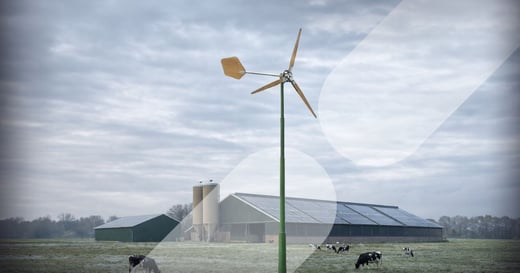
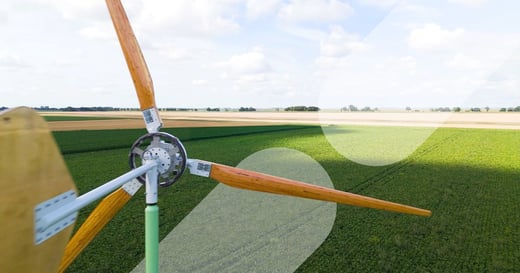
| With its modest scale and characteristic wooden blades, the EAZ-model windmill is designed to sit naturally next to farm buildings, fields, and open rural surroundings. During the location analysis, Ecoways looks at how the EAZ windmill would fit into the landscape, so it supports the farm without feeling out of place. |
3. Local and provincial policy
The next condition is policy. Municipalities and provinces both influence where small windmills can be placed.
This can decide:
- Whether small windmills are allowed in your area
- Whether they are only allowed for agricultural businesses
- Maximum height or placement rules
- Distance requirements
- Landscape or visual conditions
- Areas where windmills are restricted or excluded
Some municipalities have clear rules for small windmills on farms, while others assess each location on an individual basis. Provincial policy can also limit what a municipality is allowed to approve.
This matters because these rules form the basis for your permit application. Before a municipality can approve a small windmill, it needs to check whether the location fits the relevant local and provincial policy. So even though the permit process is a separate step, the policy layer already gives you a reliable first indication of whether you’ll be able to invest in the project.
>>> Want to know more about permits? For a deeper look, read our in-depth guide on the permit process for farmers.
The Ecoways Way |
| While Ecoways can’t influence whether a municipality will approve a small windmill, we can help you understand what your local and provincial rules mean for your project. During our location analysis, we check whether your farm is located in a province of the Netherlands where placing an EAZ windmill may be possible, what conditions are likely to apply, and what information the municipality may need. This gives you a clearer first indication before you invest time and money into the next steps. Once we’re optimistic, we can also support the permit process with the right technical information, drawings, and documentation. |
4. Nearby protected nature
Nearby nature is another important layer to consider.
If your farm is close to a protected nature area, nature reserve, waterway, or sensitive habitat, this may affect whether you can place a small windmill. It can also influence where on the farmyard the windmill could be placed.
Make sure to check:
- Distance to Natura 2000 areas
- Nearby protected landscapes or nature reserves
- Waterways, tree lines, hedges, and nesting areas
- Whether your farm location falls inside or near an excluded zone
Being close to nature does not imply an immediate no, just that your farm needs to be assessed with that context in mind.
5. Ecology: birds, bats, and protected species
Closely related to nature, ecology specifically considers the species of animals nearby.
For small windmills, birds and bats are usually the main concern. They may use certain areas for feeding, nesting, resting, or flying between habitats.
This can depend on features around the farm, such as:
- Trees and hedgerows
- Watercourses
- Barns and older buildings
- Open fields
- Known bird or bat routes
- Nearby nesting or resting areas
On some farms, ecological research may be needed to check whether a windmill could affect protected species. Here, the exact site matters more than the general area.
The Ecoways Way |
|
Research cited by Ecoways shows that the impact of small windmills on birds and bats is limited, but exact placement still matters. That is why Ecoways does not install an EAZ model windmill without considering the ecological context first. During the location analysis, the team checks whether the position is close to trees, hedgerows, buildings, nesting areas, or possible flight routes for birds and bats. Where needed, Ecoways can also work with ecological quick scans and preventive measures, such as choosing a better position or temporarily stopping the turbine during specific risk periods. |
6. Wind conditions on your farm
Finally, the wind conditions also need to be suitable.
A small windmill only makes sense if there is enough clean, usable wind at the location.
By clean wind, we mean wind that reaches the turbine without too much disruption from nearby objects. Buildings, trees, silos, hedgerows, or other obstacles can create turbulence. This makes the wind less steady, which can reduce the windmill’s output and put more strain on the turbine.
Regional wind maps can give an indication, but the exact position on your farm is just as important.
Good wind conditions depend on:
- Average wind speed in the area
- Openness of the landscape
- Distance from trees and buildings
- Turbulence around the turbine position
- The height and placement of the windmill
An open agricultural setting is often a good starting point, but even on a windy farm, a poorly chosen position can reduce yield.
| The Ecoways Way |
| Regional wind maps are useful, but they only tell part of the story. As part of the location analysis, Ecoways calculates the expected yield based of an EAZ windmill based on your specific farm location, nearby objects, and local wind speeds and directions. |
FAQ: Placing a small windmill
Can I place a small windmill on any farm?
No. A small windmill needs the right combination of space, wind conditions, distance to neighbors, landscape fit, local rules, and ecological context. That is why a location analysis is an important first step.
How much space do I need for a small windmill?
That depends on the farmyard layout, nearby buildings, access, neighboring properties, and the exact windmill position. You not only need empty space, but also a suitable place with enough room for installation, maintenance, and clean wind.
Does a small windmill need to be placed close to the farmyard?
In many cases, yes. Placement near the existing farmyard often makes more sense because it keeps the system connected to the business and helps the windmill fit naturally into the farm landscape.
Can I place a small windmill near a nature area?
Possibly, but it depends on the exact location. Nearby nature areas, waterways, tree lines, nesting areas, or protected habitats may affect where the windmill can be placed and whether extra ecological checks are needed.
How does Ecoways check whether my farm is suitable?
Ecoways carries out a location analysis. The team looks at your farmyard, surrounding buildings, neighbors, local rules, landscape fit, ecology, and wind conditions to assess whether an EAZ model windmill is realistic for your farm.
The Takeaway
A small windmill can be a strong addition to your farm’s energy system, but only when the location is the right fit.
Your farmyard, distance to neighbours, local and provincial rules, landscape fit, nearby nature, ecology, and wind conditions all play a role.
If you’re considering a small windmill, such as the EAZ-model, the first step is understanding how those conditions apply to your farm. During an Ecoways location analysis, our team checks the practical, technical, and environmental conditions on-site and gives you a clear first indication of what may be possible.
Want to know whether an EAZ-model windmill is a good fit for your farm? Book a location analysis with Ecoways.