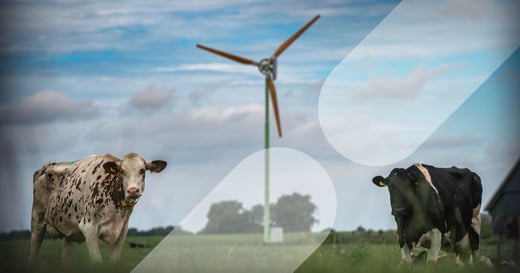
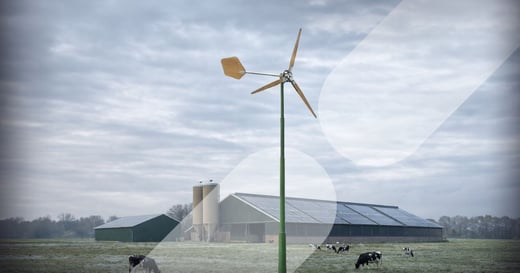
- A small wind turbine for agricultural use generates electricity directly on your farm and supports daily operations
- It is most effective when the energy is used on-site, alongside existing demand
- Output and profitability depend on location, wind conditions, and system setup
- Systems designed for farms are built to contribute consistently across the year
Energy on the farm used to run in the background. For many, that’s no longer the case.
Grid capacity isn’t always available when you need it. Feeding electricity back is less predictable. And more parts of the business now run on electricity, pushing costs up each year.
A small wind turbine brings part of that energy production back onto your own land. It generates electricity on-site and feeds it directly into your daily operations.
These systems are built to deliver steady output over time, often working alongside solar panels and, increasingly, energy storage.
In this guide, you’ll get a clear overview of small wind turbines for agricultural use. We cover how they work, where they fit, what they can generate, what they cost, and what to consider before installing one. Each section is designed to give you a clear, concise answer (with links to more detailed articles where needed) so you can make well-informed decisions for your farm.
What is a small wind turbine for agricultural use?
A small wind turbine for agricultural use is a turbine installed at the farm level that generates electricity locally and feeds it directly into your business operations.
Unlike large wind turbines, which are built for large-scale energy production, small wind turbines are designed for on-site use. They are scaled to match the energy demand of farms and are typically installed on or near the yard.
Compared to residential turbines, agricultural systems are built for higher loads and more consistent usage.
In practice, this means:
- Installation on agricultural land, often close to existing buildings
- Output that is used directly within the business
- A system that is in line with the daily energy demand of the farm
The EAZ-model small wind turbine is an example of this approach, designed specifically for agricultural environments where reliability and predictable output are key.

|
>>> FURTHER READING For more information on the EAZ-model small windmill specifications, take a look at our product overview. |
How big is a small wind turbine for agricultural use?
A small wind turbine for agricultural use is sized to fit into a farm's day-to-day operations - so not too big, but not tiny either.
The EAZ-model wind turbine typically has:
- A mast height of around 15 metres
- A maximum tip height of approximately 21.6 metres
- A rotor diameter of 13.2 metres
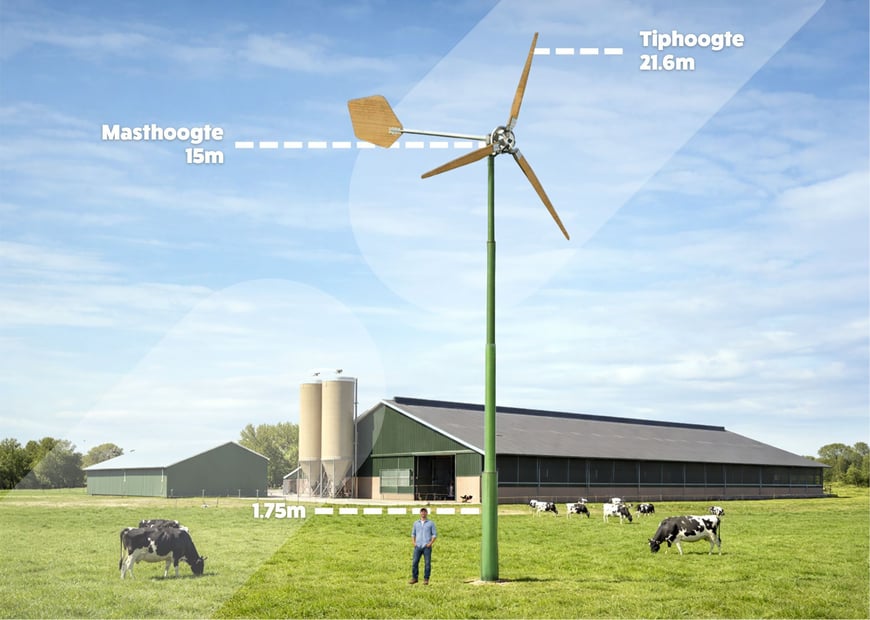
In practice, this means the turbine is tall enough to capture stable wind conditions while still fitting within the farm's layout.
It is usually installed on open land near existing buildings, where it can operate without obstruction and integrate into daily operations.
Why small wind turbines are becoming increasingly relevant for farms
The interest in small wind turbines for agricultural businesses is growing due to structural changes in how energy is produced and used.
Grid congestion is one of the main drivers. Many farms cannot expand their connection or face limitations when feeding energy back into the grid.
In the Netherlands, around 14,000 farms and SMEs are currently waiting for a new or upgraded electricity connection, with waiting times in some regions reaching up to 10 years.
At the same time:
- Energy prices remain volatile
- Feed-in compensation is less certain
- Electricity demand on farms continues to increase
In practice, farms are looking for ways to gain more control over how and when they produce and use energy. A small wind turbine is a great solution, generating energy on-site, so you’re less dependent on when or if the grid is available.
What is a small wind turbine used for?
A small wind turbine for agricultural use is typically used to support the farm’s own electricity demand.
On the farm, this means:
- Supplying energy directly to daily operations
- Supporting base load consumption
- Covering part of the demand during peak usage
- Reducing reliance on grid electricity
- Increasing resilience during disruptions
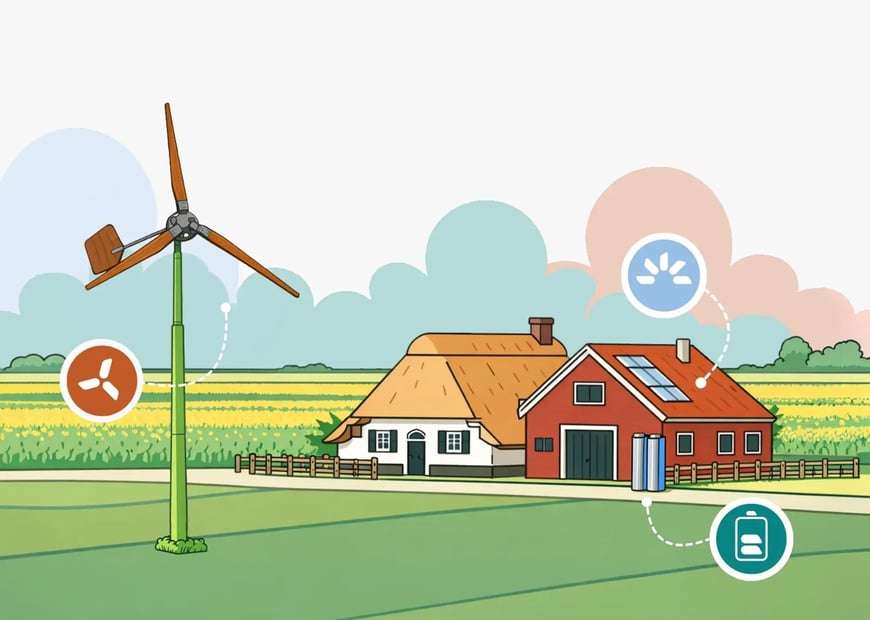
For many farms, a wind turbine works alongside existing solar panels. Solar production peaks during the day and in summer, while wind provides energy in the evenings, overnight, and during colder months.
|
|
>>> FURTHER READING For more on how systems are connected, see: Connecting Your Small Windmill to the Farm. |
Which agricultural businesses can benefit from a small wind turbine?
A small wind turbine is most relevant for agricultural businesses with a consistent and relatively high electricity demand.
Based on our experience, this often includes:
- Dairy farms with continuous energy usage
- Arable farms with storage and processing needs
- Intensive agricultural operations with stable demand profiles
|
|
>>> FURTHER READING Want to see a list of all farm types we cater our EAZ-model windmill to? Check out our Energy for Farmers page. |
There are also a few practical indicators that determine whether a turbine is a good fit:
- High annual electricity consumption (70.000 - 120.000 kW per year)
- Sufficient open space for installation
- Existing solar panels that do not cover total demand
- Limitations due to grid congestion
It’s important to know that a small wind turbine is not suitable for every situation. Location, wind conditions, business type, and energy usage all play a role.
|
|
>>> FURTHER READING You can read more here: Why Our Farm-Yard Turbine Is Designed for Farms, Not Private Homes |
How does a small wind turbine work?
A small wind turbine converts wind into electricity through a mechanical and electrical process.
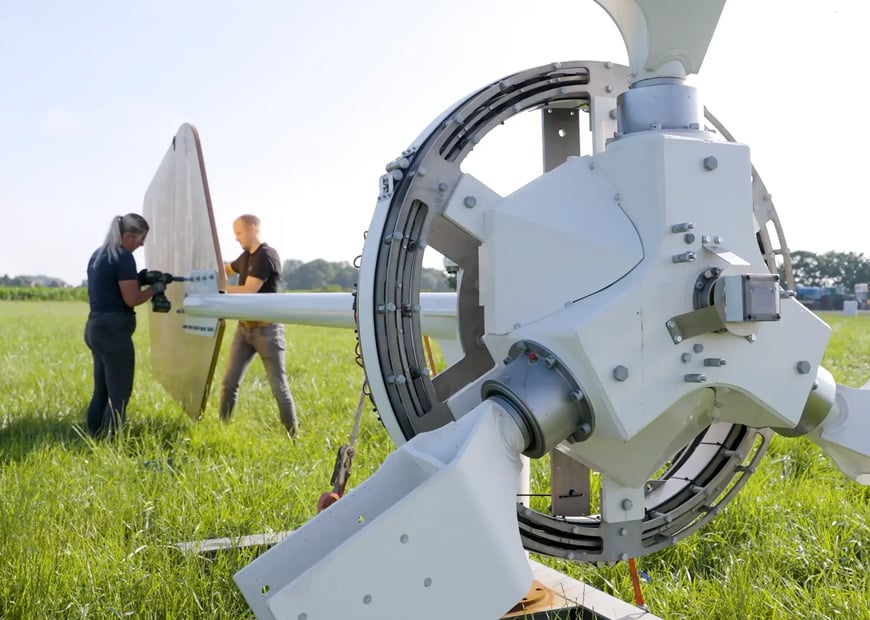
Wind turns the rotor blades. The rotor drives a generator, which produces electricity. This electricity is then converted into a usable form and supplied to your farm.
The main components include:
- Rotor blades that capture wind energy
- A generator that converts movement into electricity
- An inverter that prepares the electricity for use
Our EAZ-model wind turbines use a robust, mechanically simple design, which offers reliability and predictable performance on the farm.
What is the output of a small wind turbine?
The energy output of a small wind turbine for agricultural use depends on several location-specific factors. There is no single number that applies to every farm.
Key factors include:
- Wind availability at your location
- Turbine height and positioning
- The type and capacity of the system
In practice, farms in open landscapes with consistent wind conditions tend to achieve higher output.
To give an indication, an EAZ-model small wind turbine is often estimated to generate around 30,000 to 40,000 kWh per year, depending on the location and setup.
For example, a poultry farm in the north of the Netherlands installed three EAZ-model wind turbines based on an annual consumption of around 120,000 kWh. Each turbine was expected to generate roughly 35,000 kWh, helping to cover a large share of the farm’s energy demand.
One of the key advantages of wind energy is that it is distributed over time. Unlike solar energy, which peaks during the day, wind contributes across the day, the night, and the seasons.
Because of these variables, output is always based on a site-specific assessment. We look at your location, wind conditions, and energy usage to estimate how much the turbine will generate and how much you can use yourself.
That forms the basis of your business case analysis, including expected yield, self-consumption, and payback over time.
What does a small wind turbine cost for agricultural use?
The cost of a small wind turbine for agricultural use depends on the system and installation conditions.
Typical cost factors include:
- Turbine size and capacity
- Installation and foundation requirements
- Site conditions and accessibility
- Integration with your existing energy system
In practice, there is no standard price. Each installation is tailored to the farm.
As an indication, an EAZ-model small wind turbine typically falls within a range of €60,000 to €100,000, depending on the location, configuration, subsidies, and installation requirements.
These systems are configured based on expected yield and integration with the existing setup, so that the installation matches the actual energy demand of the business.
When is a small wind turbine profitable?
The profitability of a small wind turbine depends on how well it aligns with your energy usage and local conditions.
Key factors include:
- Total electricity consumption
- The share of energy used directly on-site
- Energy prices and future expectations
- Investment and installation costs
From experience, profitability improves when a larger share of the generated energy is used directly within the business.
In practice, this often comes down to having a consistent energy demand. For example, a mixed farming business in Belgium installed two small wind turbines with an expected annual output of 60,000 kWh. In the first year, actual production exceeded this at over 65,000 kWh. Combined with rising energy prices, the system quickly became a valuable part of the farm’s energy setup.
Payback periods vary and are always calculated based on the specific situation. This is why a detailed analysis is required to determine whether a small wind turbine is financially viable for your farm.
Do you need a permit for a small wind turbine?
In most cases, installing a small wind turbine requires a permit from your municipality.
The exact requirements depend on your location. Rules are set at the local level and are based on the municipal zoning plan, as well as national regulations
Permits typically consider:
- Height and placement of the turbine
- Impact on the surrounding environment
- Local zoning rules
Requirements can vary between municipalities and provinces, and local rules may be stricter depending on the area.

|
>>> FURTHER READING The full explanation can be found here: The permit process for a small wind turbine (in Dutch). |
Subsidies for small wind turbines: what schemes are available?
Subsidies and financial incentives are available for small wind turbines, but they vary by region and are updated regularly.
In the Netherlands, two commonly used schemes are:
- Investment subsidy (ISDE): The Investeringssubsidie duurzame energie en energiebesparing (ISDE) is a subsidy that reduces the upfront cost of purchasing a small wind turbine. This makes the initial investment lower and improves the overall business case.
- Fiscal benefits (KIA): The Kleinschaligheidsinvesteringsaftrek (KIA) is a tax scheme that allows you to deduct part of the investment from your taxable profit in the year of purchase.
The ISDE scheme has been extended and remains available, with budget allocated across multiple years to support renewable energy solutions for agricultural businesses and SMEs.
Because these programs are subject to change and may differ depending on your situation, it is important to check the current conditions and eligibility for your location.
Ecoways is happy to think this through with you. Together, we look at which schemes may be relevant to your situation. We can apply for some subsidies on your behalf. This gives you a clearer picture of the investment, subsidy opportunities, and what this means for the business case.
|
|
>>> FURTHER READING For a more detailed breakdown, see: Subsidy schemes for small wind turbines (in Dutch). |
Key considerations when installing a small wind turbine
When installing a small wind turbine, it is important to look at the full context of the farm, not just energy production.
This includes:
- Landscape integration and visibility
- Ecological factors such as birds and wildlife
- Noise, depending on placement
- Maintenance and long-term service
These factors are well understood and are part of how modern systems are designed and installed.
Research in the Netherlands shows that the ecological impact of small wind turbines is limited. Studies commissioned by provinces and NedZero indicate relatively low numbers of bird and bat collisions, especially when turbines are placed carefully.
In practice, location plays a key role. Turbines are positioned away from buildings, tree lines, and flight paths, and ecological checks are carried out in advance. Where needed, temporary measures such as stopping the turbine during specific periods can be applied with minimal impact on annual production.
With the right setup, a small wind turbine can fit well within both the technical and environmental context of the farm.
Combining a small wind turbine with solar and energy storage
A small wind turbine is often part of a broader energy system.
Wind and solar energy complement each other. Solar panels produce more energy during sunny periods, while wind turbines can generate energy during evenings, overnight, and in colder months.
Adding energy storage increases flexibility by allowing you to store energy and use it when needed.
In practice, this combination helps reduce dependence on the grid and creates a more stable energy system for the farm.
|
|
>>> FURTHER READING We explain this in more detail here: Small wind turbine or solar panels? |
FAQ: Small wind turbines for agricultural businesses
How much electricity does a small wind turbine produce on a farm?
A small wind turbine for agricultural use typically generates between 30,000 and 40,000 kWh per year, depending on wind conditions, location, and turbine type. Farms in open, wind-rich areas often achieve higher output. The exact yield is always calculated based on a site-specific assessment
What does an EAZ-model windmill cost?
An EAZ-model small wind turbine typically costs between €60,000 and €100,000, depending on location, configuration, and installation. The exact price varies per farm and is based on a site-specific calculation, including expected yield and system setup.
How big is an EAZ-model small wind turbine?
An EAZ-model small wind turbine typically has a mast height of around 15 metres, a tip height of approximately 21.6 metres, and a rotor diameter of 13.2 metres. This size allows it to capture stable wind conditions while still being suitable for installation on or near the farmyard.
When is a small wind turbine a good fit for a farm?
A small wind turbine is most suitable for farms with:
- A high and consistent electricity demand
- Available space for installation
- Existing solar panels that do not cover total demand
- Limitations due to grid congestion
Each situation is different, so a location and usage analysis is needed to determine fit.
Do you always need a permit for a small wind turbine in the Netherlands?
Yes, in most cases you need a permit from your municipality before installing a small wind turbine. Requirements depend on local zoning rules and can vary by region. The process typically considers placement, height, and environmental impact.
Is a small wind turbine profitable for agricultural businesses?
A small wind turbine can be profitable when a large share of the generated electricity is used directly on the farm. Profitability depends on energy usage, wind conditions, energy prices, and investment costs. Under favorable conditions, payback periods are often estimated at 6 to 10 years, but this varies per situation.
Wrapping things up
A small wind can help you take more control over your energy supply and reduce reliance on the grid. For farms with a consistent energy demand, it becomes a stable part of how electricity is produced and used on-site.
Whether it is the right solution depends on your location, energy usage, and long-term plans. That is why each installation starts with a clear analysis of your situation, including expected yield, self-consumption, and overall return.
Systems like the EAZ-model small wind turbine are specifically designed for agricultural use. They are built to operate reliably in farm environments, with a relatively simple mechanical setup, low maintenance requirements, and a steady energy contribution throughout the year.
If you want to understand what this could look like for your farm, the next step is to explore how the EAZ-model small wind turbine works in practice.